
Have you ever sat in the dental chair and heard your dentist call out numbers like “one four” or “three six”? It may sound random, but it’s not.
Those numbers follow the Canadian tooth numbering system. This system helps dental professionals identify each tooth quickly and clearly. Once you understand how it works, dental visits feel much less confusing.
Let’s break it down in simple terms.
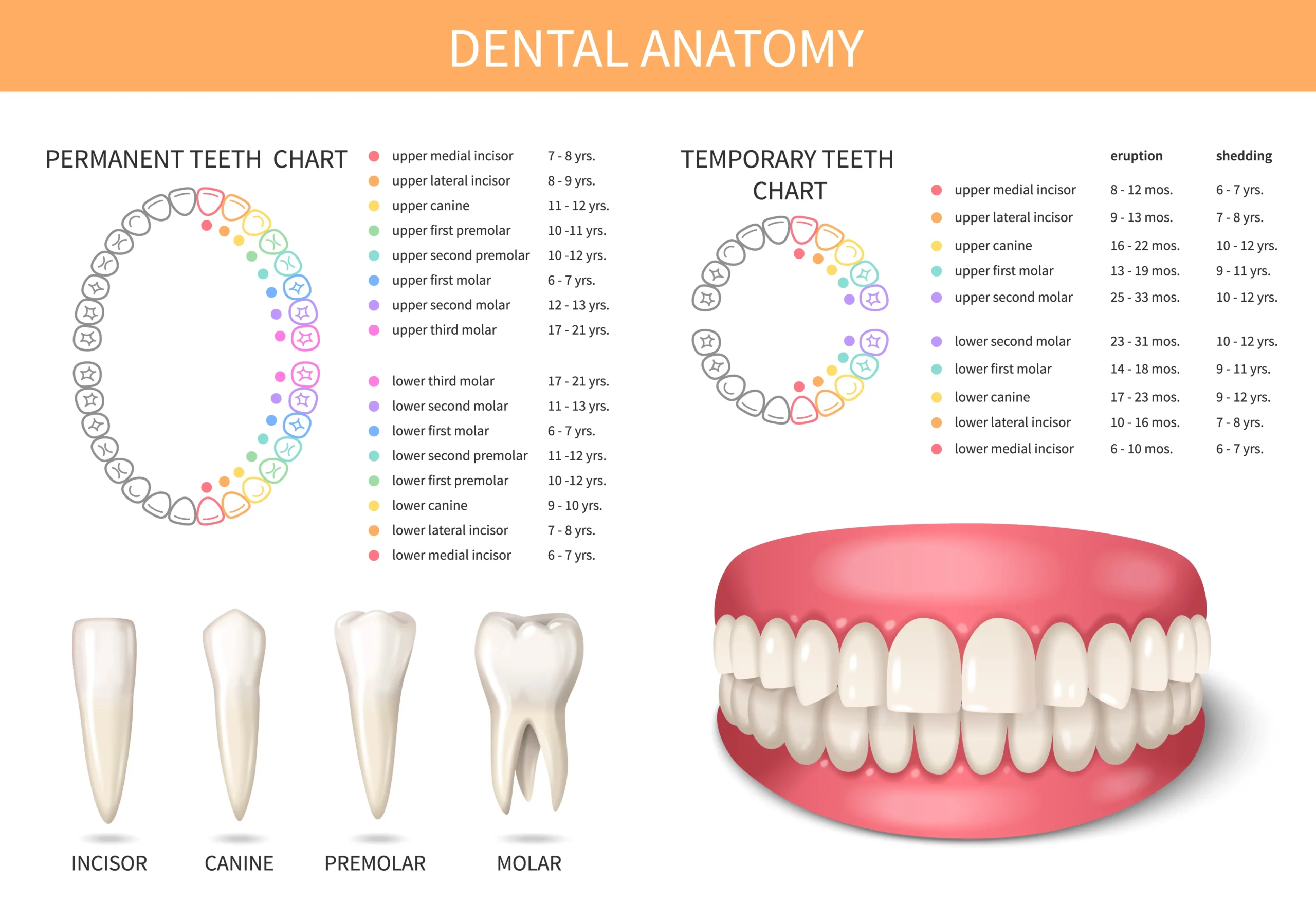
The Four Quadrants of the Mouth
To stay organized, dentists divide the mouth into four sections called quadrants. This makes it easy to describe the exact location of a tooth.
Permanent (Adult) Teeth
- Quadrant 1 – Upper Right
- Quadrant 2 – Upper Left
- Quadrant 3 – Lower Left
- Quadrant 4 – Lower Right
Primary (Baby) Teeth
- Quadrant 5 – Upper Right
- Quadrant 6 – Upper Left
- Quadrant 7 – Lower Left
- Quadrant 8 – Lower Right
Important: Right and left are always from the patient’s point of view. If you are facing someone, their right side appears on your left.
How Adult Teeth Are Numbered
Adults usually have 32 permanent teeth. Each quadrant contains eight teeth.
Within each quadrant:
- Teeth 1 and 2 – Incisors (cutting teeth in the front)
- Tooth 3 – Canine (the pointed tooth beside the incisors)
- Teeth 4 and 5 – Premolars (used for tearing and crushing)
- Teeth 6, 7, and 8 – Molars (used for grinding food)
More specifically:
- Tooth 6 – First molar
- Tooth 7 – Second molar
- Tooth 8 – Third molar (wisdom tooth)
Four quadrants × eight teeth each = 32 permanent teeth.
How to Read a Tooth Number
Each tooth is identified using:
Quadrant number + Tooth number
For example:
Tooth 14
- Quadrant 1 (Upper Right)
- Tooth 4 (First premolar)
Pronounced: “one four,” not “fourteen.”
Tooth 37
- Quadrant 3 (Lower Left)
- Tooth 7 (Second molar)
Pronounced: “three seven.”
This system allows the dental team to quickly identify the exact tooth being discussed.
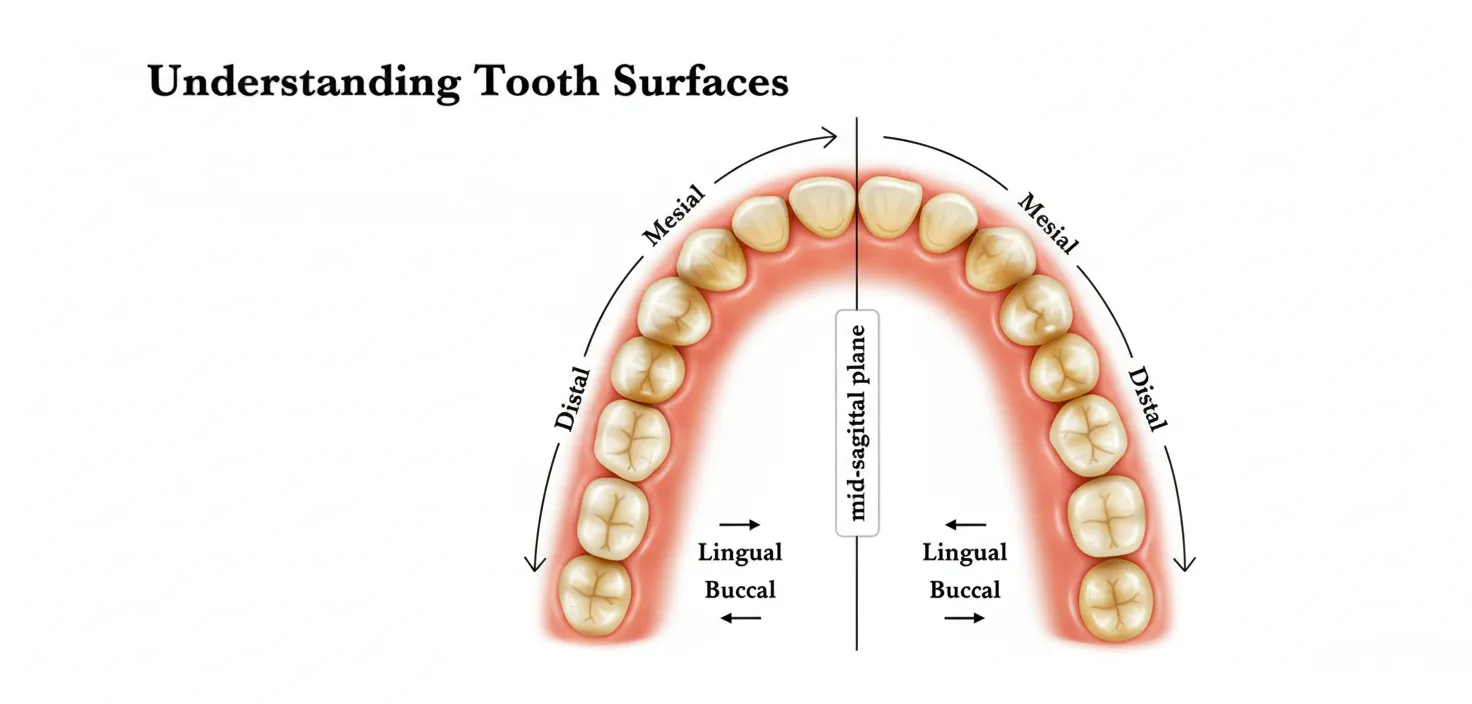
Understanding Tooth Surfaces
Dentists also describe specific parts of a tooth. If you need a filling, you may hear these letters:
- M – Mesial (toward the front of the mouth)
- D – Distal (toward the back of the mouth)
- O – Occlusal (chewing surface of back teeth)
- B – Buccal (surface facing the cheek)
- L – Lingual (surface facing the tongue)
For example:
If your dentist says “36 MO,” it means quadrant 3, tooth 6, on the mesial and occlusal surfaces.
Common Dental Terms Explained
Dental language becomes easier once you know a few basics.
Types of Teeth
- Primary dentition – Baby teeth
- Permanent dentition – Adult teeth
Mouth Anatomy
- Maxilla – Upper jaw
- Mandible – Lower jaw
- Temporomandibular joint (TMJ) – The joint connecting your jaw to your skull
- Palate – Roof of your mouth
Tooth Structure
- Enamel – Hard outer layer
- Dentin – Layer beneath enamel
- Pulp – Inner area containing nerves and blood vessels
- Cusp – Raised point on a tooth
- Interproximal – Space between teeth
Dental Conditions and Procedures
- Calculus – Hardened plaque
- Scaling – Professional cleaning to remove plaque and calculus
- Caries – Tooth decay
- Composite – Tooth-coloured filling material
- Root canal – Treatment that removes infected pulp
- Crown – A custom-made cap placed over a damaged tooth

Why Understanding Dental Terms Matters
Knowing basic dental terminology helps you:
- Feel more relaxed during appointments
- Understand treatment recommendations
- Ask clearer questions
- Take an active role in your oral health
Dentistry may sound technical, but the system is logical and structured.
Next time you hear your dentist call out numbers, you’ll know exactly what they mean, and you might even speak the language back.